
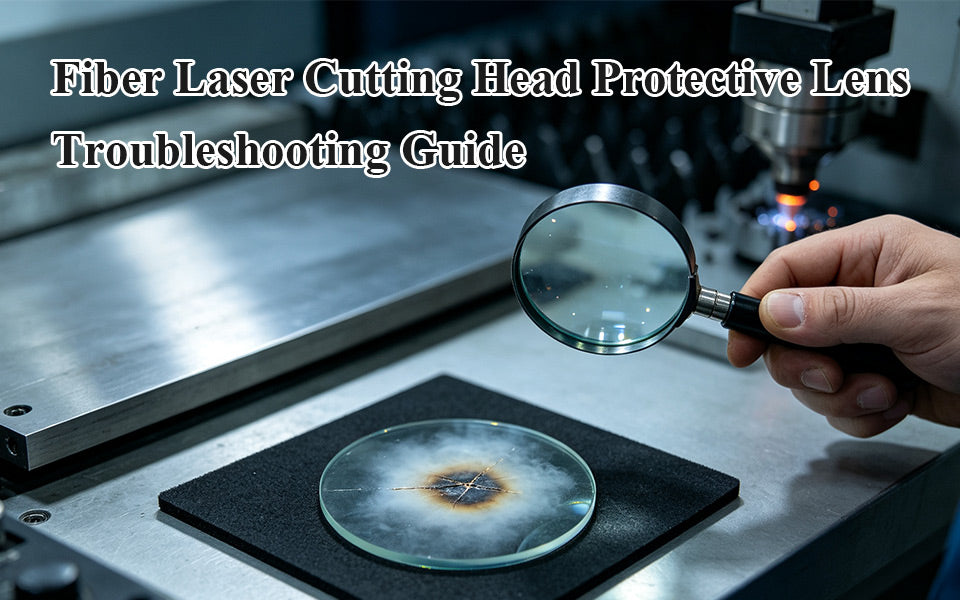
Fiber Laser Cutting Head Protective Lens Troubleshooting Guide
Protective lenses are consumable components of fiber laser cutting heads. Frequent lens damage is usually related to cutting spatter, gas flow, installation, piercing parameters, contamination, cooling, or optical path issues.
You can first identify the possible cause according to the condition of the damaged protective lens.
1. Identify the Damage Based on the Lens Condition
| Lens Damage | Possible Cause | Recommended Inspection |
|---|---|---|
| Burn marks or melted contamination on the outer side of the lens | Cutting spatter or molten metal rebounding upward | Check nozzle, ceramic ring, gas pressure and piercing parameters |
| Burn spots or damage on the inner side of the lens | Back reflection, nozzle misalignment or optical path deviation | Check nozzle centering, optical path and cutting parameters |
| Lens cracked or broken directly | Retaining ring tightened too much or thermal shock | Check retaining ring pressure, cooling system and temperature changes |
| Lens repeatedly burns within a short time | Optical path deviation, excessive back reflection, contamination or other cutting head problems | Perform a complete inspection and contact professional service if the problem persists |
2. Troubleshooting Steps
① Check the Nozzle and Ceramic Ring
Check the contact surface between the nozzle and ceramic ring.
Make sure there is no metal slag, iron debris or other contamination on the contact surface.
A tilted, damaged or improperly installed nozzle can cause unstable gas flow. This may cause molten metal and slag to splash upward and hit the protective lens.
If the nozzle is deformed or damaged, replace the nozzle immediately. If the ceramic ring is damaged or abnormal, replace it as well.
② Clean the Lens Cavity Before Installing a New Lens
Before installing a new protective lens, use nitrogen to blow out metal particles, dust and other debris from inside the lens cavity.
Make sure the lens is installed correctly and cleanly.
The retaining ring should be tightened moderately.
Do not overtighten the retaining ring.
Excessive tightening may create uneven mechanical stress on the lens. During cutting, temperature changes can cause thermal stress, which may result in cracking or breaking of the protective lens.
③ Check Cutting Gas, Gas Pressure and Air Quality
Higher gas pressure does not always mean better cutting performance.
Excessive gas pressure may create turbulent airflow and carry molten slag back into the cutting head, increasing the risk of lens contamination and damage.
Also check:
-
Gas hose and fitting connections for leakage
-
Air dryer condition
-
Oil-water separator
-
Drainage of the air system
-
Filter condition and replacement schedule
When using compressed air
Compressed air may contain oil and moisture.
Oil mist and water vapor entering the cutting head can contaminate the protective lens and accelerate lens burning or damage.
Therefore, regularly check the air dryer and oil-water separator, drain accumulated water in time, and replace filter elements according to the maintenance schedule.
When using nitrogen or oxygen
Make sure the gas purity meets the requirements of the laser cutting system and the cutting process.
Impure cutting gas may also accelerate protective lens contamination and damage.
④ Check Piercing Parameters
If the protective lens is damaged almost every time during piercing, piercing spatter should be one of the first things to check.
During piercing, a large amount of molten metal and slag may be generated and splash upward toward the cutting head.
Depending on the material and plate thickness, try to:
-
Reduce piercing power appropriately
-
Enable pre-piercing if available
-
Increase gas blowing delay appropriately
-
Optimize piercing parameters
-
Reduce excessive molten metal and spatter during piercing
If the lens is burned immediately after piercing, do not simply replace the lens repeatedly without checking the piercing process.
⑤ Check the Capacitive Sensor and Cutting Head Cooling System
Keep the capacitive sensor and related areas free from metal slag.
Metal contamination may cause abnormal height sensing, resulting in unstable cutting-head height and increasing the risk of nozzle collision and upward spatter.
Also check the cutting head cooling system:
-
Is the cooling water flow normal?
-
Is the water temperature within the required range?
-
Is the cooling system working properly?
-
Is there any blockage or abnormality in the cooling circuit?
Poor cooling can cause the protective lens to operate at excessively high temperatures and shorten its service life.
3. Special Attention When Cutting Highly Reflective Materials
When cutting aluminum, copper, brass or other highly reflective materials, do not directly use the same parameters as carbon steel.
Highly reflective materials can produce stronger back reflections, which may damage the protective lens or other optical components.
We recommend:
-
Using conservative cutting parameters during initial testing
-
Optimizing laser power and cutting speed according to the material
-
Using appropriate piercing parameters
-
Monitoring the protective lens condition during initial cutting
-
Avoiding excessive back reflection whenever possible
4. When Should You Stop Troubleshooting?
If you have completed all of the inspections above and the protective lens is still burning frequently, the problem may be related to:
-
Optical path deviation
-
Nozzle misalignment
-
Excessive back reflection
-
Abnormal cutting head components
-
Other internal optical or mechanical problems
In this situation, do not adjust the optical path by yourself.
Improper optical path adjustment may cause more serious damage to the cutting head, laser source or other optical components.
Please contact the cutting head manufacturer or a qualified professional service technician for further inspection and repair.
Quick Troubleshooting Guide
Outer-side burn marks → Check cutting spatter, nozzle, ceramic ring and piercing parameters.
Inner-side burn spots → Check back reflection, nozzle centering and optical path.
Lens cracked/broken → Check retaining ring pressure and thermal shock.
Lens burns immediately after piercing → Check piercing power, pre-piercing and gas blowing delay.
Lens becomes dirty or burns gradually → Check cutting gas quality, oil/water contamination and air filtration.
Lens burns repeatedly after all checks → Stop self-adjustment and contact professional service to inspect the optical path and cutting head.
Important: Protective lenses are precision optical components. Always keep the lens cavity clean and dry, install the lens correctly, and avoid touching the optical surface directly with your fingers.